How to verify a peptide certificate of analysis
A certificate of analysis is the most useful document a peptide seller can give you, and the easiest to misread. Here is how to read one line by line, verify it on the lab's own website, and spot the common tricks.
Open the report on the lab's own website using the task number and key, check that its lot number matches your vial, and make sure it covers identity, purity and the measured amount, not just one of them. A screenshot you cannot open on the lab's site is not verified.
Check a certificate now
Certificate checker
Paste a Janoshik verification link (or a task number and key) to get a clean link that opens on the lab's own site. Then tick what the report shows.
Weak or unverified. Ask for a proper third-party report before paying.
Reading a certificate line by line
| Line | What it tells you |
|---|---|
| Laboratory | Who ran the test. Look the lab up independently. Well-known independent labs used by peptide buyers include Janoshik; there are others. |
| Task or report number, and key | The code that lets you open the report on the lab's own site. No code, no verification. |
| Sample or lot identifier | Should match the batch or lot number on your vial and invoice. |
| Compound and label claim | What the sample was sold as, and how much it claimed to contain. |
| Identity | Usually by mass spectrometry (MS). Confirms the molecule is what the label says. |
| Purity | Usually by HPLC, reported as a percentage. Tells you how much of what is in the vial is the target peptide. |
| Amount (quantity) | The measured milligrams in the vial. A 99% pure vial that holds 60% of the label is still a short vial. |
| Endotoxin | A separate test for bacterial contamination markers, reported in EU. Not part of purity. |
| Date | When the analysis was done. Older reports may not reflect current stock. |
How to verify it on the lab's site
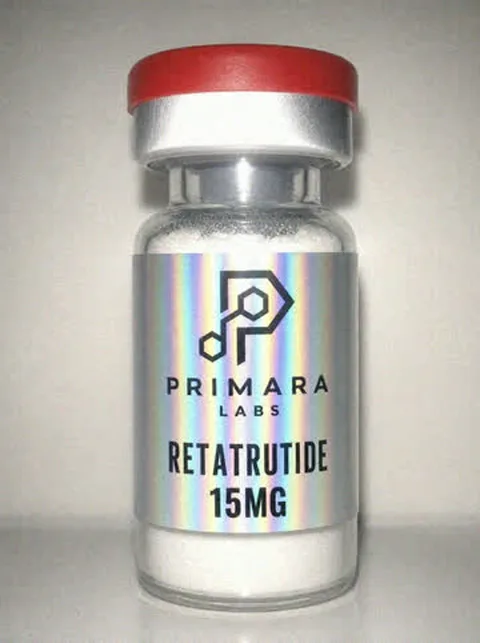
- Find the lab's website yourself by searching its name. Do not click a link the seller sends until you know the real domain.
- Open its verification page and enter the task number and key, or open the verification link and check the domain in your browser bar.
- Compare the report on the lab's site with the one the seller showed you: compound, lot, results and date.
- Check the lot number against your vial or invoice.
Common tricks
- The borrowed report. A real report from another seller or a manufacturer, shown as if it covers this stock.
- The partial report. An endotoxin-only or purity-only result presented as full testing.
- Purity without amount. A high purity number on a vial that is under-filled.
- The edited image. Numbers changed in a screenshot. Opening the report on the lab's site defeats this.
- The old report. A test from long ago, before the current stock was bought.
A certificate shows what one sample tested as. It does not show that a product is safe or approved for use in people.
A real example
Paste this report's link into the checker above to see how it works. Note what it does and does not cover.
- Lab
- Janoshik
- Test
- Bacterial endotoxin (LAL)
- Result
- 6.066 EU per vial
- Analysed
- 21 September 2026
- Task
- 234146
- Key
- H2KI86I8GWB4
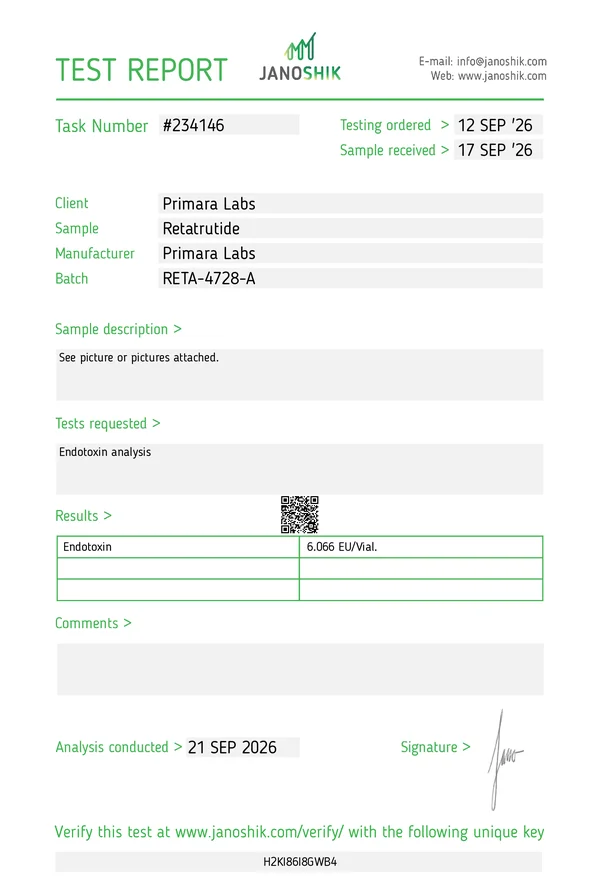 Tap to open the original on Janoshik's site
Questions
How do I verify a Janoshik report?
Open verify.janoshik.com and enter the task number and key, or open the verification link directly. The report on Janoshik's site is the real one; compare it with what the seller showed you.
Can a certificate be faked?
Images can be edited, and real reports can be copied onto another seller's page. That is why you open the report on the lab's site and check that the lot number matches your vial.
Does a certificate mean a peptide is safe?
No. It shows what one sample tested as. It does not show that the product is safe or approved for use in people.
Is 98% purity good?
For research peptides, results above about 98% by HPLC are commonly reported. Purity alone is not enough; check identity and the measured amount too.
Not medical or legal advice. Peptides sold as research compounds are not registered medicines with FDA Philippines and are not approved for use in people. If you are thinking about any compound for your own health, speak to a licensed physician first.
Ready to order? Primara Labs delivers same day in Metro Manila.
Prices from ₱1,190 ($20) a vial, a 60 day money-back guarantee if an accredited lab disagrees with the label, and orders placed on WhatsApp with the owner.
Keep reading
Peptide documents to ask for before you buy
Five documents, what each settles, and how to check it yourself.
Read the guide →CheckingPeptides in the Philippines on Reddit: what threads ask, answered
The PH subreddits, the six questions threads leave open, and a worked check you can copy.
Read the guide →Start hereHow to choose a peptide supplier in the Philippines
A ten-point scorecard you can use on any seller, and how Primara Labs scores on its own published claims.
Read the guide →